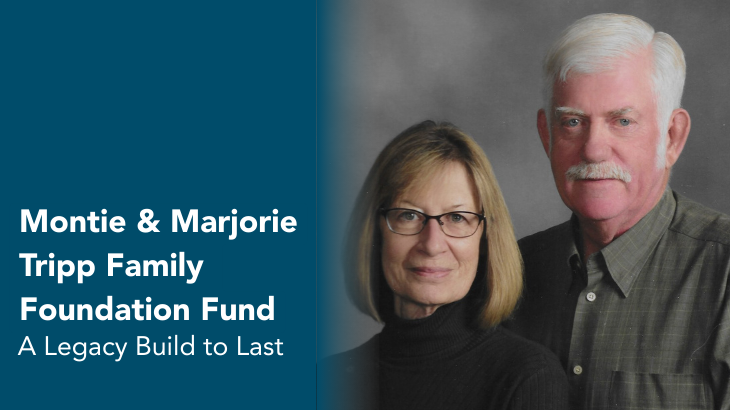
Montie Tripp’s relationship with Truman Heartland Community Foundation spans decades—and reflects a core belief that has guided his giving from the start: invest locally, stay informed, and create a legacy that keeps working long into the future.
“I like to be able to see and hear about things locally… ” Montie shared. “I like to see the local impact out of our contributions.”
While Montie and his wife formally established the Montie and Marjorie Tripp Family Foundation Fund in 2006, their connection to Truman Heartland Community Foundation (THCF) began much earlier—through family involvement and a deep commitment to Eastern Jackson County.
Montie’s parents, Garland and Pauline Tripp, were engaged fundholders, and their legacy fund continues to make an impact today. Over time, Montie and his brother, Gary, also became involved, building a family tradition of charitable giving rooted in community.
In 2011, Montie and Marjorie became founding members of the Truman Heartland Community Foundation Legacy Society, establishing a commitment to charitable giving in their personal legacy.
From Fundholder to Community Leader
As Montie approached retirement—after a 40-year career in construction and utilities infrastructure, rising from trainee to president at Garney —he found himself with more time to invest in what mattered most. Beginning in 2015, he served on THCF’s Board of Directors for three full terms (9 years), and contributed to multiple committees, including finance, development, and scholarships.
“That was the interesting part to me,” he explained. “It was one thing to give money to charity, but… it was great to learn all the steps prior to that money going out to do something good.”
His service deepened his understanding of local needs—and reinforced what he values most about working with a community foundation: trusted stewardship and the ability to direct giving with clarity and purpose.
Giving That’s Personal—and Visible
Montie’s philanthropy is deeply connected to his life experiences and relationships. One of his primary charitable priorities is Children’s Mercy Hospital, inspired by the health journey of his grandson, Brendan Elam. After Brendan needed a liver transplant at age 10 in 2010—and recovered remarkably well—Montie and his family’s giving to Children’s Mercy became even more meaningful.
He also supports a range of causes he feels closely tied to, including Community Services League, and organizations such as Resource Health and other faith-based missions. One cause includes a longstanding personal connection to the missionary efforts of Crecer Foundation in Argentina, that he continues to support and follows their progress.
His guiding principle is consistent: give where you can see the impact, or where you personally know and trust the people doing the work.
“With some big national fund—we have no clue where the money goes,” he said. “I like to do things that I’m… more actively involved in.”
“I was so thankful for all the opportunities I was given,” he said. “It was good to give back… to give somebody else an opportunity to succeed.”
- Montie Tripp, Fundholder
A Scholarship Champion Through Local Education
Montie’s commitment to education runs deep as well. He served on the Oak Grove School Board for 27 years and helped support the growth of scholarship giving through the district’s education foundation—work that now connects with THCF through administrative support and charitable fund stewardship.
He also maintains scholarship funds connected to specific career paths—for nursing and engineering—reflecting both family connections and his own professional background.
“Every donor has… different criteria for the type of student education they'd like to support," Montie explained. "Engineering and nursing were important fields for our family."
A Standout Strategy: Using Life Insurance to Expand Legacy Giving
What makes Montie’s story especially inspiring—and what staff point to as a model of strategic philanthropy—is how he has used life insurance to grow and strengthen his charitable legacy.
Montie has structured multiple life insurance policies so that THCF ultimately receives the proceeds, which then flow into his fund and are distributed according to the charitable plan he has already laid out.
“I always looked at life insurance being a way to secure the dollar amount that I wanted to go to a particular place,” he shared.
In other words, instead of relying solely on what he could contribute over time, life insurance allows Montie to establish a larger future gift—that is not impacted by market volatility. This allows him to give a gift that supports the causes he cares about and strengthens the long-term sustainability of his fund.
Just as important: Montie has designed his giving plan with longevity in mind. Much of his charitable distribution structure is intended to function as a permanent endowment-style impact, where annual giving can continue over time.
“That way, it ends up being a perpetual fund… a forever fund,” he explained.
The endowment serves as a "forever fund" with THCF, because by following the spending policy which is reviewed annually by the board, the fund will continue to grow over time while making grants. That way the grants available in 20 years will have the same purchasing power as they do today.
I always looked at life insurance being a way to secure the dollar amount that I wanted to go to a particular place.
- Montie Tripp, Fundholder
Trust, Guidance, and Confidence in Where the Money Goes
Montie also appreciates the behind-the-scenes support THCF provides—particularly when donors want help evaluating an organization before giving.
“The Foundation is great because they can research a nonprofit and see how their fund are being used."
For Montie, that matters. He’s thoughtful about stewardship and transparency, and he wants his giving to align with real impact—not overhead or uncertainty. That focus is one reason he continues to value local philanthropy and the guidance of a community foundation.
Looking Ahead: A Family Legacy of Giving
Montie has also planned for continuity by naming a successor to help carry his charitable intent forward. His oldest daughter, Stacy Elam, is positioned to help guide the fund in the future and involve other family members as needed—ensuring his philanthropy remains both personal and purposeful over time.
It’s a reflection of what Montie has quietly modeled for decades: generosity that is planned, local, values-driven, and built to last.
“I was so thankful for all the opportunities I was given,” he said. “It was good to give back… to give somebody else an opportunity to succeed.”